
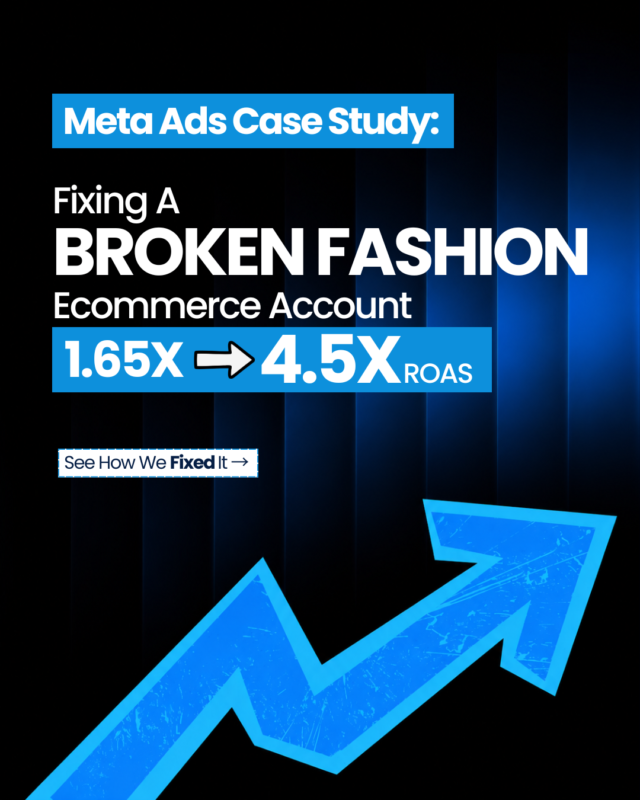
Fashion Ecommerce Case Study: 1.65x to 4.5x ROAS While Scaling Ad Spend 7x
Most “scale your ad spend” advice assumes your account is already healthy. This case study is for the more common situation: an account that’s been running for a while, spending real money, and still leaving performance on the table because nobody built it correctly in the first place.
The Starting Point
This client is a US-based ecommerce fashion store. Before working with us, they were running Meta Ads through a previous agency. In September 2024, the account spent $7,518.06 and generated 71 purchases worth $12,383.65 — a 1.65x ROAS. Barely break-even once you factor in cost of goods, shipping, and returns, which run high in fashion.
When we audited the account, the problems weren’t subtle:
- No real campaign structure. Everything sat in a flat setup with no clear separation between cold, warm, and hot audiences.
- Zero creative testing. The same handful of ads had been running for months with no fresh variations to fight fatigue.
- No scaling logic. Budgets moved up or down manually, based on gut feeling rather than rules.
- No DPA campaigns. For a fashion catalog, this is close to malpractice — dynamic product ads are typically the single highest-performing format for stores with a large SKU range, and this account didn’t have a single one running.
- The only product ads in the account were carousels, and several of them were actively pushing out-of-stock items to paying traffic.
None of this is unusual. It’s what happens when an account gets set up once and then left alone while spend keeps climbing.
What We Changed
We didn’t touch everything at once — that’s how you tank an account that’s already fragile. We worked through it in phases.
Rebuilding the structure. We rebuilt the campaign architecture around the funnel: dedicated cold prospecting, a warm layer for people who’d engaged but not converted, and a hot layer for cart abandoners and past purchasers. Each layer got its own budget logic instead of sharing one undifferentiated pool.
Turning on DPA. We launched dynamic product ads pulling directly from the product catalog, so the exact item a shopper viewed was the item they got shown again — in-stock, correctly priced, and personalized without any manual creative work. For a fashion store with hundreds of SKUs, this immediately started outperforming the static carousels it replaced.
Creative testing, actually done properly. We started systematically testing new ad concepts instead of running the same set until they died. Losers got cut fast; anything that showed early signs of working got fed more budget and iterated on.
Automatic rules for scaling winners. Rather than relying on someone checking the account daily and adjusting by feel, we set up automated rules that scaled budget on ads hitting performance thresholds and pulled back on ones that didn’t. Winning ads got more spend within hours of proving themselves, not days.
A CBO scaling campaign with a bid cap. Once creative and structure were working, we layered in a Campaign Budget Optimization campaign with a bid cap to push additional spend into the account without letting cost-per-result drift upward the way uncapped scaling usually does.
Funnel-aware retargeting. Instead of one generic retargeting pool, we mapped retargeting to where each user had dropped off. Someone who viewed a product but didn’t add to cart saw different messaging than someone who abandoned checkout. That precision is a big part of why conversion at the bottom of the funnel improved as much as it did.
The Results
| Metric | September 2024 | November 2024 | Change |
|---|---|---|---|
| Ad spend | $7,518.06 | $55,316.77 | +7.4x |
| Purchases | 71 | 1,516 | +21.4x |
| Purchase value | $12,383.65 | $249,092.11 | +20.1x |
| ROAS | 1.65x | 4.50x | +2.7x |
Two months later, spend had scaled 7.4x — and ROAS had nearly tripled alongside it, landing at 4.50x. Purchase volume went from 71 orders to 1,516. That combination is the part most agencies can’t deliver: it’s easy to hit a strong ROAS on a small budget, but holding and growing that efficiency as spend multiplies is a different problem entirely.
Why This Worked
None of the individual pieces here are exotic. DPA, funnel-based retargeting, CBO scaling, automated rules — these are known tactics. What made the difference was doing all of them correctly, in the right sequence, on an account that had none of the foundational structure in place to support scale.
Fashion brands in particular tend to underuse DPA and overuse static carousels, which is exactly backwards given how catalog-dependent the category is. If your account is running on manual carousels, has no clear cold/warm/hot separation, or scales budget by feel instead of rules, that’s usually the first place to look before spending more.
Want results like this for your store? See how our done-for-you Meta Ads service works.
