Open up most ecommerce ad accounts and you’ll find the same thing: one campaign called something like “Sales – All” or “Conversions – Broad,” quietly trying to do everything at once. It’s finding new customers, chasing cart abandoners, and re-selling to people who bought last month — all with the same audience, the same budget pool, and usually the same three creatives that have been running since March.
It’s not surprising this happens. Meta Ads Manager doesn’t force you to think about where someone is in their relationship with your brand. But your customers are very much not all in the same place, and treating them like they are is one of the quickest ways to watch your cost per acquisition creep up for no obvious reason.
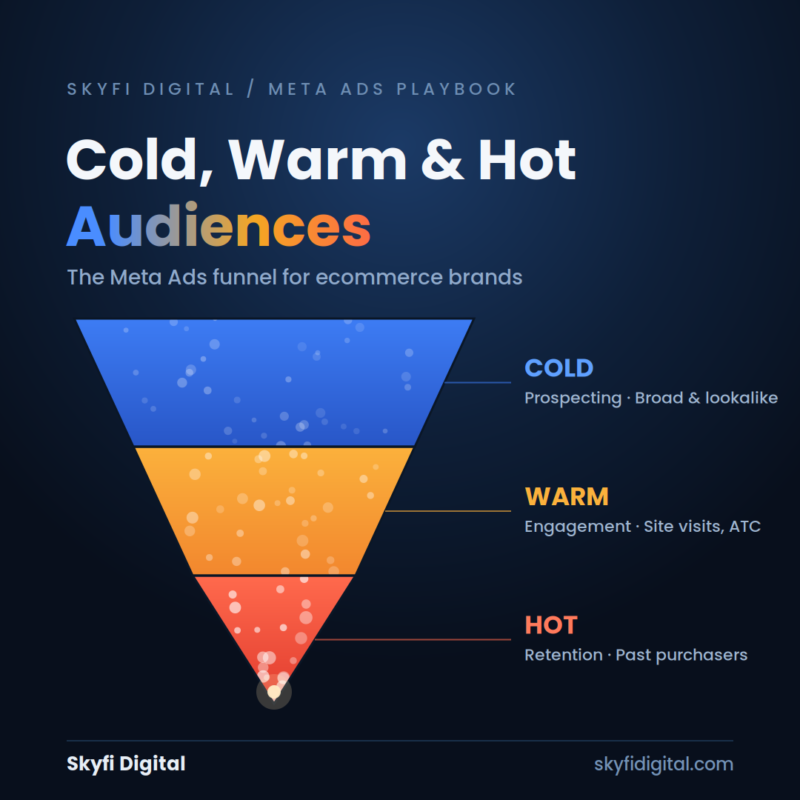
The fix is a campaign structure built around three audience temperatures: cold (people who don’t know you yet), warm (people who’ve shown some interest but haven’t bought), and hot (people who already have, or are about to). Below is how to think about each of these, how to actually build campaigns around them, and where most accounts go wrong.
Does This Still Matter After Advantage+?
Fair question. Meta’s algorithm has changed a lot over the past couple of years — Advantage+ Shopping, broad targeting, AI-driven audience expansion. A lot of the manual audience-building advertisers used to do is now handled automatically.
But none of that gets rid of the need to think in cold, warm, and hot terms. It just moves where that thinking happens.
Even inside a broad or Advantage+ campaign, the algorithm still needs creative built for the person it’s showing it to. Someone seeing your brand for the first time needs a different ad than someone who added a product to their cart three days ago and then got distracted by something else (as people do).
If your account has already moved to a leaner, post-Andromeda setup with fewer, broader campaigns, this framework hasn’t gone anywhere — it’s just living at the ad set, audience signal, and creative level instead of as three separate campaigns. We get into that more advanced structure in The Only Meta Ads Campaign Structure You Need in 2026 (Post-Andromeda). This post is the layer underneath that — what these audiences actually are, and how to set things up if you’re starting from scratch or untangling an existing account.
The Three Audience Temperatures
Cold: people who’ve never heard of you
Cold audiences haven’t interacted with your brand at all. In practice, this usually looks like:
- Broad targeting with little to no interest restriction
- Lookalike audiences (1–3%) built from your best customers
- Advantage+ Shopping with no manual audience overlay
- Interest or behaviour-based audiences relevant to your category
This layer’s job is to introduce your brand and product, not close the sale on the spot. Expect a higher cost per click and a lower ROAS here than anywhere else in the account — that’s not a red flag, that’s just what prospecting looks like.
Creative for cold audiences has to stand on its own, with zero context. Lead with the product, the benefit, and proof — reviews, UGC, before-and-afters. And steer clear of anything that assumes familiarity, like “come back and finish your order.” That line means nothing to someone who’s never visited your site.
Warm: people who know you but haven’t bought yet
This is the audience most ecommerce brands underuse, and honestly it’s where a lot of “easy” revenue is sitting unclaimed. Warm covers anyone who’s shown interest without converting:
- Website visitors — all of them, or segmented by the pages they viewed
- Add-to-cart or initiate-checkout without purchase
- Video viewers at 25%, 50%, or 75% completion
- People who’ve liked, commented, saved, or visited your profile
- Email subscribers who haven’t bought yet
Because the awareness work is already done, warm audiences convert at a noticeably lower cost than cold ones. The creative job shifts too — instead of introducing the brand, you’re now handling objections. Shipping cost, return policy, sizing, “is this actually worth it” — whatever is realistically standing between this person and a purchase.
Recency matters a lot here. Someone who abandoned their cart yesterday is in a very different headspace than someone who did it two weeks ago, and your messaging should reflect that if your catalogue and budget allow for the segmentation.
Hot: people who’ve already bought, or are about to
Hot is your past purchasers and your highest-intent visitors right now — and it’s consistently the best-performing layer in the account, while also being the one most accounts neglect entirely.
This includes:
- Past purchasers, segmented by recency, frequency, or category
- Customer lists uploaded from your CRM or email platform
- Initiate-checkout in the last one to three days
- High-intent visitors — multiple product views, long sessions
Here’s the thing a lot of accounts get wrong: they run one “retargeting” campaign that throws a customer from last month in with someone who abandoned their cart an hour ago. Those are two completely different people who need two completely different messages.
For hot audiences, the angle should be repeat purchase, cross-sell, or replenishment — not “you forgot something in your cart” on repeat. Someone who bought a skincare product 45 days ago is ready for a refill reminder, not another ad for the thing they already own.
Putting It Into a Campaign Structure
Once the three audiences make sense, the structure mostly builds itself. A solid foundational setup looks like this:
Campaign 1 — Prospecting (Cold) Objective: Sales, or Advantage+ Shopping Audience: Broad / Advantage+, 1–3% lookalikes from purchasers, interest-based test audiences Creative: Product-led, benefit-driven, social proof
Campaign 2 — Engagement Retargeting (Warm) Objective: Sales Audience: Website visitors (last 14–30 days), cart/checkout non-purchasers, video and social engagers Creative: Objection handling, reviews, FAQs, urgency
Campaign 3 — Customer Retention (Hot) Objective: Sales, or Catalogue Sales for cross-sell Audience: Past purchasers by product/category, customer lists, high-intent recent visitors Creative: Cross-sell, replenishment, loyalty/VIP, new arrivals
The part people skip — and the part that matters most — is exclusions. Your warm campaign shouldn’t be showing ads to existing customers. Your cold campaign shouldn’t be targeting anyone who’s visited your site in the last 30 days. Skip this step and you’re effectively bidding against your own campaigns and confusing the algorithm about what “success” even looks like.
If Advantage+ Shopping is doing your heavy lifting, that’s fine — let it be Campaign 1 with broad signals, and run Campaigns 2 and 3 as separate, audience-restricted campaigns so Advantage+ doesn’t quietly absorb them too.
How to Split the Budget
There’s no magic ratio that works for every brand, but as a starting point for an account with a reasonably proven product:
| Audience | Campaign | Typical budget share |
|---|---|---|
| Cold | Prospecting | 60–70% |
| Warm | Engagement retargeting | 20–25% |
| Hot | Customer retention | 10–15% |
If you’re a newer brand, you’ll naturally lean more toward prospecting — your warm and hot pools are just too small to spend much against yet. As your customer base grows, though, that hot layer often punches way above its weight, ROAS-wise. Don’t be shy about letting it take more budget than its audience size would suggest, especially if you sell anything people buy more than once.
One more thing: don’t tinker with this daily. Give each campaign a few weeks to gather enough data before you start reshuffling percentages.
Where Accounts Usually Go Wrong
A few patterns show up over and over in account audits:
Everything lives in one campaign. No retargeting layer means every single sale is a cold conversion. That’s expensive, and it’s also why performance feels random — there’s no structure for the algorithm to learn from.
No exclusions between campaigns. Cold ads reaching existing customers, warm ads reaching people who already bought — both waste money and make your brand look a bit disorganised to the person seeing the ad.
One creative set for everyone. An ad introducing the brand showing up in a retargeting campaign is a missed opportunity — that person already knows who you are. Tell them something new.
The hot layer doesn’t exist. This is the one that stings most, because it’s usually the cheapest fix with the fastest payoff. If you’ve got past purchasers and no campaign speaking to them, that’s free money sitting on the table.
A Template to Start From
If you’re building this from zero, here’s a version you could realistically set up this afternoon:
| Campaign | Audience | Budget | Creative angle |
|---|---|---|---|
| Prospecting | Broad / Advantage+ / 1–3% lookalikes | 65% | Product + benefit + social proof |
| Engagement retargeting | Visitors (30 days), cart/checkout non-purchasers | 25% | Objection handling + offer |
| Customer retention | Past purchasers, customer list | 10% | Cross-sell + replenishment |
Launch it, leave it alone for two to three weeks, then start refining based on what the data actually tells you — not what you assumed going in.
When You’re Ready to Go Further
This three-campaign structure is the foundation, and for a lot of accounts it’s enough for a long time. But as you scale — more spend, more purchase history, more SKUs — you’ll likely move toward the leaner, signal-driven structure that’s become the norm post-Andromeda: fewer, broader campaigns, with audience signals doing more of the work that rigid segmentation used to do.
We walk through that setup, including campaign budget optimisation and the “pack” approach to ad sets, in The Only Meta Ads Campaign Structure You Need in 2026 (Post-Andromeda). And if you’re wondering what “good” actually looks like once your structure is dialled in, our Meta Ads ROAS benchmarks guide has real numbers from real accounts.
FAQ
What is the best Meta Ads campaign structure for ecommerce? Start by splitting campaigns according to audience temperature — one for cold/prospecting, one for warm audiences who’ve engaged but not bought, and one for hot audiences like past customers and high-intent visitors. Give each its own budget, creative, and exclusions so they’re not competing with each other.
What’s the difference between cold, warm, and hot audiences in Meta Ads? Cold means no relationship with your brand yet — broad targeting, lookalikes, interest audiences. Warm means they’ve engaged but not bought — site visitors, cart abandoners, social engagers. Hot means they’ve already bought or are showing strong intent right now — past customers, recent checkout starters, customer lists.
How much of my Meta Ads budget should go to retargeting? A reasonable starting point is 60–70% prospecting, 20–25% engagement retargeting, and 10–15% retention. That said, if you sell something people buy repeatedly, your retention budget can — and probably should — grow over time, because that’s usually where your best ROAS lives.
Do I still need separate cold, warm, and hot campaigns with Advantage+ Shopping? Yes, generally. Advantage+ is great as your prospecting engine because it’s built for broad reach, but it works best alongside dedicated, audience-restricted campaigns for warm and hot — with exclusions in place so Advantage+ doesn’t start competing for the same people.
Final Thoughts
None of this guarantees a specific ROAS — nothing does. But getting your structure right removes one of the most common (and most fixable) sources of wasted ad spend: showing the wrong message to the wrong person at the wrong point in their journey with your brand.
If you’d like a second opinion on your current account structure, Skyfi Digital offers a free Meta Ads account audit — book yours here.
