
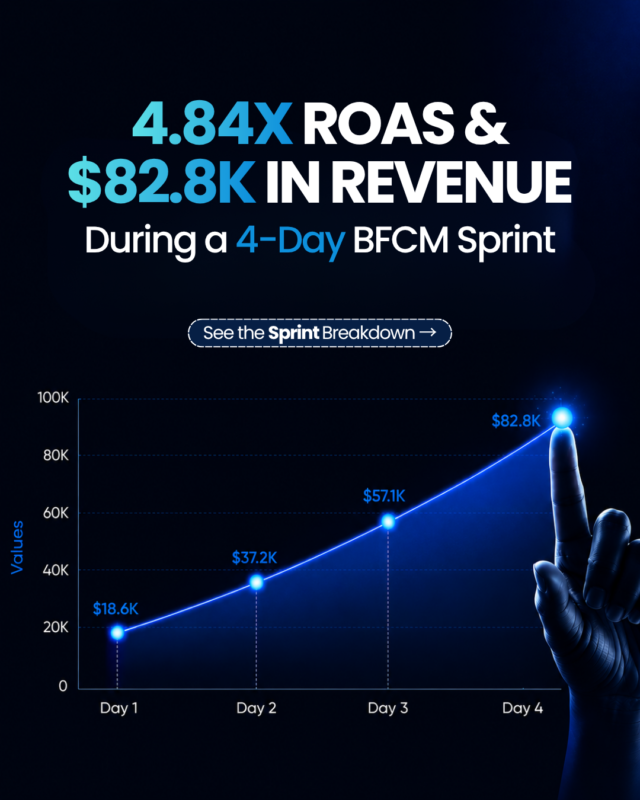
Case Study: 4.84x ROAS and $82.8K in Revenue During a 4-Day BFCM Sprint
Black Friday isn’t the time to test new strategy. It’s the time results either show up or they don’t — and for this fashion ecommerce brand, the numbers over a single 4-day window told a clear story.
This is the same US fashion store we scaled from $7,000 to $55,000 in monthly spend after rebuilding their account structure. Black Friday–Cyber Monday was the real stress test: could that structure hold up, and actually perform, when spend and competition both spike at once?
The Window
From November 29 to December 2, 2024, the account ran at a marketing spend rate of 20.67% of revenue — a healthy ratio for peak season, when acquisition costs across Meta typically climb as every advertiser fights for the same inventory.
The Numbers
- Total ad spend: $17,122.01
- Total revenue: $82,852.16
- Blended ROAS: 4.84x
- Total purchases: 551
A 4.84x blended ROAS during BFCM is meaningfully above what most ecommerce accounts see in this window, where CPMs typically jump 30–50% compared to a normal week. Holding a near-5x return while everyone else’s costs are rising isn’t luck — it’s what a properly structured account with pre-built scaling rules and tested creative is supposed to do.
Where the Return Came From
The account-level average masked some standout individual performance. A handful of ad sets did the heaviest lifting:
- One ad returned 18.45x ROAS on just $265.30 in spend — a small-budget, high-efficiency winner that likely would’ve been starved of budget in a less disciplined account.
- Another returned 9.08x ROAS on $192.70 spend, reinforcing that some of the strongest returns during BFCM came from smaller, tightly targeted placements rather than the biggest budget lines.
- The account’s largest single spend line, $5,419.20, still converted at a solid 5.34x — proof that the scaling structure held even where the most budget pressure was concentrated.
That spread — small efficient winners plus a big spend line still performing well — is what you want to see in a peak-season account. It means the scaling rules were doing their job: protecting budget for what was working, without starving it in favor of guesswork.
Why This Matters
Most BFCM horror stories come from one place: an account that was never built to scale in the first place gets thrown into the highest-competition week of the year, and ROAS collapses under the pressure. This account didn’t have that problem, because the groundwork — campaign structure, creative testing, automated scaling rules — was already in place months before Black Friday arrived.
BFCM doesn’t create good accounts. It exposes whether the account was already good.
The Takeaway
If your Meta Ads account is bleeding efficiency the moment spend increases — during BFCM or any other high-traffic period — the problem usually isn’t the season. It’s the structure underneath it.
