The Meta Ads campaign structure that worked in 2024 is no longer the structure that wins in 2026. With the rollout of Andromeda — Meta’s retrieval-based AI delivery system — the rules of how campaigns, ad sets, and creatives should be organised have fundamentally changed. Brands still running the old structure: multiple campaigns, fragmented ad sets, stacked interest layers, default retargeting — are bleeding budget while the algorithm fights itself.
For the full picture on Meta Ads strategy — ROAS benchmarks, audience structure, and scaling rules — read our complete guide on how to scale your ecommerce brand with Meta Ads.
Why the Old Meta Ads Campaign Structure No Longer Works
The old structure looked like this: a prospecting campaign with broad ad sets testing individual creatives, a separate retargeting campaign hitting 14-day engagers and 30-day visitors, and a retention campaign for existing customers. Each layer was intentional — and it worked cleanly for three-plus years.
Andromeda broke it. The algorithm no longer needs you to manually separate audiences by funnel stage. It reads your creative assets, identifies behavioural patterns in real time, and decides who to show your ad to — across cold, warm, and hot audiences simultaneously. When you fragment that process into multiple campaigns with overlapping audiences, you create signal competition. Campaigns cannibalise each other’s data. CPMs rise, ROAS drops, and the account looks broken when the structure is the problem.
The Post-Andromeda Meta Ads Campaign Structure
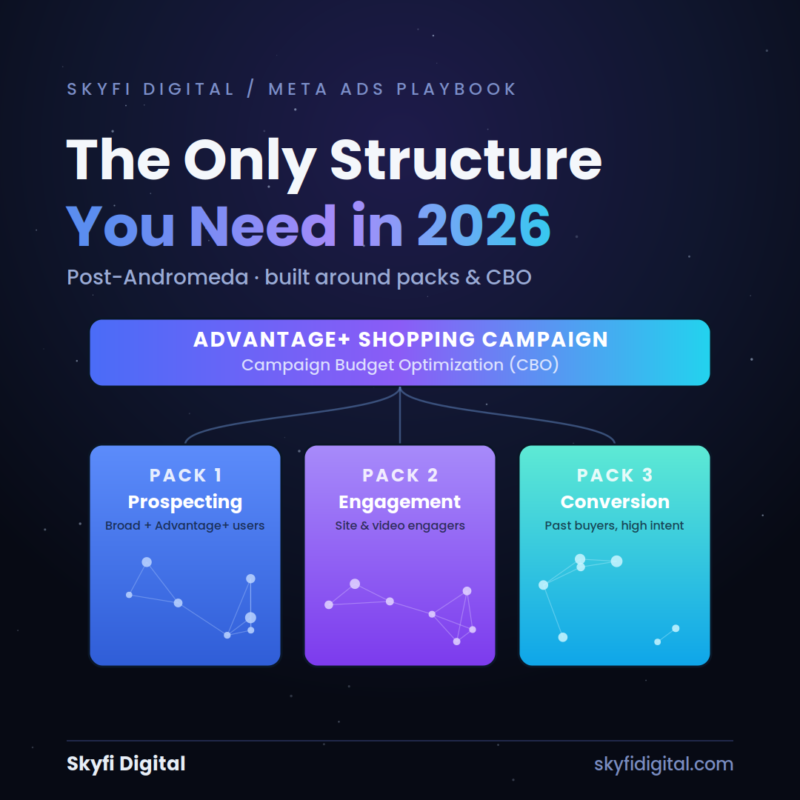
This structure reduces complexity without losing control. It runs on three campaigns — one conditionally optional — and organises creative testing through a pack system inside a single CBO prospecting campaign.
Campaign 1 — Core Prospecting (CBO)
One campaign, campaign budget optimisation, multiple ad sets — each representing a distinct avatar and creative concept combination, called a pack.
Why CBO, not ABO: CBO lets the algorithm distribute budget dynamically across packs based on real-time performance. ABO forces equal spend regardless of what’s working. In a post-Andromeda account, you want budget to concentrate on the pack that is producing — not split evenly across all of them.
Audience settings inside each pack:
- Broad targeting — no interest layering on standard packs
- Exclude all-time purchasers (uploaded from Klaviyo or your CRM)
- Set language explicitly to match your ad copy — do not allow auto-translation
- Placements: fully open — Advantage+ placements, let Meta decide
The Pack System: How to Organise and Launch Creatives
Each ad set inside your prospecting CBO is a pack. A pack groups creatives by one avatar and one creative concept. This is the fundamental unit of testing in this structure.
Pack naming convention: Pack [Number] — [Avatar Name] + [Concept Name]
How to launch a new pack:
- Duplicate your existing pack ad set exactly
- Rename it with the new avatar and concept
- Keep all ad set settings identical
- Load the new creatives inside the duplicated ad set
- Set an ad set spending minimum equal to 1x your target CPA
The spending minimum on new packs is the key mechanism. It guarantees new creative concepts get enough spend to be evaluated, while CBO still favours proven packs with the bulk of budget. Without this minimum, new packs never spend meaningfully and your testing loop breaks.
The interest group ad set: Run one additional ad set within the same CBO — your best performing creatives of all time, but with a single adjacent interest applied. The purpose is to test how that interest expands reach, not to retest the creative. Choose an interest adjacent to your brand, not a direct competitor.
Campaign 2 — Retention
A dedicated campaign targeting only people who have already purchased. This runs completely separately from prospecting, with no audience overlap.
Audiences: All-time purchasers + 180-day purchasers
Ad types to run:
- Evergreen brand ads
- Sale and promotion announcements
- New product launches
- Upsells and downsells based on purchase history
Retention is one of the highest-ROAS segments in any ecommerce account. Running it as a separate campaign gives you clean visibility into what your existing customer base generates, separate from new customer acquisition metrics.
Campaign 3 — Retargeting (Conditional)
This is the biggest structural change from the old approach. Retargeting remains a core pillar of a full-funnel Meta Ads account — but in 2026 it is data-dependent, not automatic.
Andromeda is now capable of identifying and converting warm audiences — engagers, site visitors, cart abandoners — through your prospecting campaign. A dedicated retargeting campaign on top may mean paying to convert the same people twice, cannibalising prospecting budget, and creating attribution confusion.
How to decide: Pull your audience breakdown data in Ads Manager. If Andromeda is already converting warm audiences inside prospecting efficiently, a separate retargeting campaign adds cost, not value.
If the data shows warm audiences are not being reached, run retargeting with:
- 14-day Facebook and Instagram engagers
- 30-day site visitors
- 90-day add-to-cart (did not purchase)
Critical Ad Set Settings
| Setting | Correct value | Why it matters |
|---|---|---|
| Campaign budget type | CBO | Dynamic spend allocation to best-performing packs |
| Performance goal | Maximise conversions — Purchase | Tells Meta to find buyers, not clickers |
| Attribution window | 7-day click, 1-day engaged, 1-day view | Maximum pixel signal across the full purchase window |
| Conversions API | Must be active | Without it, pixel data is incomplete and optimisation breaks |
| Audience exclusions | All-time purchasers excluded from prospecting | Keeps new customer acquisition cost clean |
| Language targeting | Set explicitly (e.g. English US, English UK) | Prevents auto-translation to unintended audiences |
| Placements | Advantage+ (fully open) | Let Meta find most efficient inventory |
| New pack spending minimum | 1x target CPA | Ensures new packs are evaluated before budget starvation |
Frequently Asked Questions About Meta Ads Campaign Structure in 2026
Build the Structure First. Then Scale.
This is not a more complex structure than the old one — it is a more intentional one. One prospecting CBO campaign with packs grouped by avatar and concept. One retention campaign running against your existing customer base. Retargeting only when the data tells you it is needed.
This structure gives the Andromeda algorithm what it needs to optimise: consolidated conversion data, clean audience separation, and creatives organised around buyer types rather than funnel stages. Get this right before you touch budget or creative.
If you want the complete picture — ROAS benchmarks, creative strategy, and scaling rules that sit on top of this structure — read our full guide: How to Scale Your Ecommerce Brand with Meta Ads: The Complete Guide.
Want us to build and run this structure for your store? Book a free strategy call — we will audit your current account setup and show you exactly what needs to change.
Book a free strategy call