Meta Ads creative strategy in 2026 is no longer one component of your campaign — it is the campaign. With the full rollout of Andromeda, Meta’s retrieval-based AI delivery system, the algorithm has fundamentally changed how it decides who sees your ad. It no longer relies on the audience parameters you set. It reads your creative, analyses patterns in the visual and copy, and uses that to find the right buyer. Creative is now the targeting mechanism.
In our full guide on how to scale your ecommerce brand with Meta Ads, we covered the creative testing framework — the 2x AOV budget rule, the kill metric, the principle of isolating variables, and when to promote winners. This post goes deeper: the mechanics behind why creative works the way it does in 2026, the format requirements that changed this year, the weekly operating rhythm, and the fatigue signals that tell you a creative is dying before your ROAS does.
Creative is the Targeting — What Andromeda Actually Changed
Before Andromeda, targeting was a separate decision from creative. You built your audience first, then built your ad. The algorithm delivered your ad to the audience you defined. Creative quality affected conversion rate. Audience quality affected who you reached.
Andromeda collapsed that separation. The algorithm now analyses your creative assets — the visual language, the hook, the emotional register, the product being shown — and uses that analysis to predict which users are most likely to convert. Your creative does not just persuade the viewer. It signals to the algorithm who to find.
This is why interest stacking is now largely redundant. You are not giving Andromeda better information by adding interest layers — you are restricting the pool it can search within. Broad targeting with strong creative gives the algorithm maximum freedom to find buyers. Narrow targeting with weak creative gives it a small pool and bad signals.
The creative similarity penalty
One consequence of Andromeda that most brands haven’t adjusted for: Meta now scores how similar your active ads are to each other. If your creative similarity score exceeds approximately 60%, the algorithm actively suppresses delivery on the duplicates. It has already found the audience for that creative — running near-identical versions does not expand reach, it cannibalises it.
Ad Formats in 2026: What Changed and What It Means for Ecommerce
Since March 2026, Meta unified the safe zones for Stories and Reels. Any creative not built natively for 9:16 — filmed landscape, repurposed from other platforms, cropped square — will either be auto-cropped poorly or delivered at a CPM premium. Film vertically from the start. It is not a preference, it is a cost structure decision. See Meta’s official Ads Guide for current format specifications across all placements.
The Hook Framework: You Have 2 Seconds on Reels
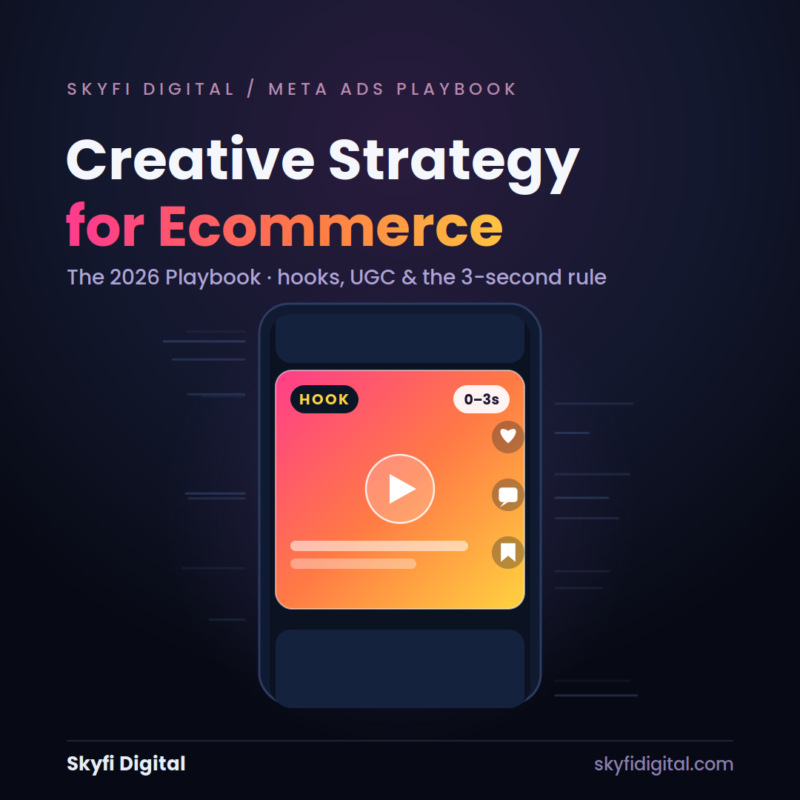
The pillar post covers the 3-second rule for video. Here is the refinement for 2026: on Reels specifically, nearly 50% of conversions happen within the first two seconds. The window is shorter than it was 12 months ago, and it will keep shrinking. Design your hook for two seconds, and anything after that is a bonus.
Four hook types that work for ecommerce
- The problem hook. Open with the problem your product solves, not the product. “My skin was breaking out every week until I found this.” The viewer self-selects in the first two seconds.
- The result hook. Lead with the outcome. Show the after before the before. A fitness product showing the transformation result in the first frame outperforms one that builds to it.
- The pattern interrupt. Unexpected visual, unusual framing, or a statement that contradicts what the viewer expects. Stops the scroll purely through disruption. Works well for high-consideration or premium products.
- The direct address. “If you sell clothes in Pakistan and your Meta ads aren’t working, watch this.” Hyper-specific qualification. Lower volume, higher intent from the right viewer.
Designing for sound on and sound off
Meta recommends designing for both. Assume the first view is silent — captions or text overlays must carry the hook independently of audio. If the viewer watches with sound on, the voiceover or music should reinforce, not replace, what the text communicates. A video that only works with sound loses every silent viewer before the hook lands.
The Weekly Creative Testing Rhythm
The pillar post covers the rules of creative testing. This is the operating cadence that makes those rules a system rather than a one-off exercise.
Two-campaign structure: One dedicated testing campaign running 10–20% of total budget. One scaling campaign holding only validated winners. Nothing moves from test to scale without hitting target CPA within the 2x AOV spend window. Nothing stays in scale without being monitored weekly for fatigue.
Weekly launch rhythm: Launch 5–10 new creatives per week inside the testing campaign. Stagger them so you have clean data on each rather than all competing for spend simultaneously in the same week.
What to test in sequence:
- Hook — the single highest-leverage variable. Same product, same offer, different opening two seconds.
- Format — once you have a winning hook, test it across video, static, and carousel to find the most efficient delivery format.
- Angle — once you have a winning format, test a new angle: problem-led vs. result-led vs. social proof vs. comparison.
This sequential approach prevents the similarity penalty from triggering while generating genuine creative diversity. Each week’s tests look different to the algorithm because they are different — not because you renamed the file.
Reading Fatigue Signals Before Your ROAS Drops
Creative fatigue shows up in your metrics before it shows up in ROAS. By the time ROAS falls, you have already lost 1–2 weeks of efficient spend. These are the signals to watch weekly, consistent with findings from Triple Whale’s 2025 ecommerce benchmark report covering nearly 35,000 Meta ad accounts:
When you see these signals, the response is not to increase budget or adjust audience. It is to launch new creatives in the testing campaign and begin retiring the fatigued asset. A creative retired with a new winner ready is a healthy account. A creative kept running past fatigue because “it worked last month” is the most common cause of unexplained ROAS decline.
Frequently Asked Questions About Meta Ads Creative Strategy
Creative is the System. Treat It Like One.
The brands winning on Meta in 2026 are not the ones with the biggest budgets or the most sophisticated audience targeting. They are the ones producing the most diverse, highest-quality creative at the fastest iteration speed. Andromeda rewards this directly — better creative gets better delivery at lower CPM. Worse creative gets suppressed regardless of how much you spend.
Build the weekly testing rhythm. Eliminate similarity. Watch the fatigue signals. Promote winners fast and retire losers faster. This is not a creative strategy — it is a production and measurement operation that happens to produce great ads.
For the full account structure that this creative system sits inside, read our guide on how to scale your ecommerce brand with Meta Ads.
Want us to run your creative testing system and scaling campaigns end-to-end? Book a free strategy call — we will review your current creative, identify what is fatiguing, and show you what to test next.
Book a free strategy call