Meta Ads for ecommerce is the single highest-ROI paid channel available to online brands today — when it’s set up correctly. Most brands running Facebook ads for ecommerce aren’t failing because Meta doesn’t work. They’re failing because they’re treating it like a boost button instead of a system.
We’ve managed over $5M in Meta Ads spend for ecommerce brands across Pakistan, the UK, and the US. The 4.6x average ROAS we hold across our client portfolio isn’t luck — it comes from a repeatable structure: the right campaign architecture, a disciplined creative testing process, and scaling rules built on data, not guesswork.
This guide covers exactly that — the account structure, the creative framework, the audience logic, and the scaling principles we apply to every ecommerce account we run. It’s written for brand owners, not media buyers. No jargon for jargon’s sake. Just the framework, with the reasoning behind it.
Our performance marketing services are built entirely on this system.
The 3-Pillar Meta Ads Account Structure for Ecommerce
The biggest reason ecommerce brands plateau on Meta — or see ROAS collapse when they try to scale — is a broken account structure. Running one or two campaigns without a clear funnel logic means you’re either burning budget on cold audiences who’ll never convert, or you’re ignoring the warm audiences who almost did.
The 3-Pillar structure solves this by treating your ad account as a full-funnel system — each pillar with a specific job, specific audiences, and specific KPIs.
For a deeper breakdown of campaign architecture, see our Meta Ads campaign structure guide.
Pillar 1 — Prospecting (Top of Funnel)
Job: Bring in cold audiences who’ve never heard of you.
Campaign objective: Conversions (Purchase) or Advantage+ Sales Campaign (Meta’s rebranded and restructured automation — more on this below)
Audiences: Broad targeting (no interest layering), Interest-based, Lookalike audiences 1–3% based on your purchaser list
Budget allocation: 50–60% of total spend
KPIs — track the full funnel journey in every campaign, not just ROAS:
Watch Landing Page Views (LPV) → Content Views (CV) → Add to Cart (ATC) → Initiate Checkout (IC) → Purchase. The ratios between each stage tell you exactly where you’re losing people. Strong CTR with weak ATC means your landing page is the problem. Strong ATC with collapsing IC means checkout friction or pricing is killing the sale. ROAS is the outcome — these stage ratios are the diagnosis. Watch them in every campaign, at every funnel stage.
The most important shift in 2025/2026: broad targeting now outperforms interest stacking on Meta for most ecommerce categories. Meta’s algorithm is sophisticated enough to find buyers without manual audience narrowing — restricting it with interest layers often limits optimisation. Start broad, let the pixel learn, and only layer interests if broad is consistently underdelivering.
Lookalike audiences built from your purchaser list (not page likes, not website visitors — actual buyers) remain one of the most powerful cold audience tools available. A 1% lookalike from 500+ purchasers will outperform most interest-based targeting.
Pillar 2 — Retargeting (Middle and Bottom of Funnel)
Job: Convert people who already showed interest.
This is where most ecommerce brands leave the most money on the table. If you’re only running cold traffic campaigns, you’re filling a bucket with a hole in it.
MOF (Middle of Funnel) — Warm audiences:
- Video viewers (50%+ watch time)
- Instagram / Facebook page engagers (last 30–60 days)
- Website visitors who didn’t add to cart
BOF (Bottom of Funnel) — Hot audiences:
- Add-to-cart, Initiate Checkout (didn’t purchase)
- Past purchasers — for upsell and repurchase campaigns
Budget allocation: 25–30% combined (15–20% BOF, 10–15% MOF)
Ad format for BOF: Dynamic Product Ads (DPA). These pull directly from your product catalogue and show users the exact product they viewed or added to cart. Expected ROAS at BOF: 6–10x is realistic for most ecommerce categories.
Key retargeting rule: Match your window to your sales cycle. A brand selling Rs. 5,000 impulse products should retarget a 7-day window. A brand selling Rs. 50,000 sofas should retarget 30–60 days. Don’t use generic windows — build them around your buyer’s decision timeline.
Attribution: Use the 7-day click window as your standard. 1-day click underreports; 1-day view inflates. 7-day click gives the most accurate picture of what Meta is actually driving for ecommerce purchase cycles.
Pillar 3 — Creative Testing (Continuous)
Creative is not a campaign. It’s a permanent system running in parallel with your prospecting and retargeting pillars.
Most ecommerce brands test creatives the wrong way: they launch 10 ads at once, wait two weeks, and pick a “winner.” That’s not a testing system — that’s guesswork with extra steps.
The right creative testing framework:
1. Isolate variables. Test one thing at a time — hook vs. hook, format vs. format, UGC vs. polished. If you change the hook, the visual, and the CTA in the same test, you learn nothing.
2. Use a dedicated testing campaign. Run creative tests in a separate campaign from your live scaling campaigns. Give each creative a total budget equal to 2x your Average Order Value (AOV). If your AOV is PKR 3,500, that creative gets PKR 7,000 to prove itself. If it hasn’t hit your target CPA by the time that’s spent — kill it. Not tomorrow. Now. This keeps your testing budget tight and your decisions data-driven rather than emotional.
3. Know your kill metric before you launch. Set a threshold upfront — for example: “If CPA exceeds 1.5x our target after the full 2x AOV budget is spent, the creative is killed.” Don’t make this decision emotionally after the fact.
4. Promote winners fast. When a creative hits your target CPA and holds ROAS above benchmark for 3–5 days, move it immediately into your scaling campaign. Creative shelf life on Meta is short — 2 to 4 weeks before fatigue sets in. Speed of iteration wins.
What actually works for ecommerce creatives in 2026:
- UGC-style video dominates cold traffic. Real customers, authentic reviews, messy backgrounds. Outperforms polished studio creative for prospecting in almost every category we’ve tested.
- Polished creative works better for retargeting. Someone who already knows your brand responds to professional imagery and clean CTAs.
- The 3-second hook is everything. In video, if the first 3 seconds don’t stop the scroll, the rest of the ad is irrelevant. Lead with the problem, the result, or a pattern interrupt — not your logo.
- Static images still convert. For fashion, home, and beauty in particular, a single high-quality product image with a strong offer in the copy often beats video for CPM efficiency.
For the full creative breakdown, read our Meta Ads creative strategy guide.
ROAS Benchmarks for Meta Ads Ecommerce Campaigns (2026)
Before we talk scaling, you need to know what success looks like — and what it doesn’t.
For the full breakdown by market, read our Meta Ads ROAS benchmarks guide.
What is a good ROAS for Meta Ads in ecommerce?
Skyfi’s average across ecommerce clients sits at 4.6x ROAS. But here’s the honest market data: the median ROAS across nearly 35,000 ecommerce brands on Meta is 1.86x (Triple Whale, full-year 2025 data). Well-optimised ecommerce campaigns typically land in the 2.5–4.0x range. Our 4.6x sits well above median — and the gap comes down to structure, creative discipline, and margin-aware optimisation, not spend volume alone.
What matters more than headline ROAS: your break-even number.
Break-Even ROAS = 1 ÷ Gross Margin %
Use gross margin — not net margin — because you need to know the point at which ad spend is covered by the margin on the product itself, before fixed overhead costs. If your gross margin after COGS and fulfilment is 40%, your break-even ROAS is 2.5x. A 3x ROAS is profitable. A 2x ROAS is burning money — even if it looks like revenue is coming in. Net margin includes overheads that exist regardless of whether you’re running ads. Using it overstates how much ROAS you actually need to justify the spend.
ROAS benchmarks by ecommerce category (2026)
| Category | ROAS Range (2026) | Notes |
| Fashion / Apparel | 2.5x – 4.5x | High competition, creative-dependent |
| Beauty / Skincare | 3x – 5x | Strong UGC performance, high LTV |
| Home & Living | 2x – 4x | Longer purchase cycle, higher AOV |
| Food & Beverage | 2x – 3.5x | Subscription models improve LTV |
| Electronics | 1.5x – 3x | High CPMs, margin-sensitive |
Note: These ranges reflect well-structured accounts. The median across all accounts in most categories sits closer to 1.8–2.5x. The ranges above are targets for accounts with proper funnel structure, strong creative, and optimised landing pages — not industry-wide averages.
Advantage+ Sales Campaigns in 2026: what’s actually changed
Meta’s Advantage+ Shopping Campaign (ASC) has been restructured and rebranded. In 2026 it is called Advantage+ Sales Campaign, and the setup has changed in ways that affect how you use it:
- Unified UI: You no longer select “ASC” as a distinct campaign type. You select the Sales objective, then choose the Advantage+ setup — often pre-selected as the default, with an “Opportunity Score” out of 100 nudging you toward automation.
- Multiple ad sets now supported: The original ASC locked you into a single ad set. Advantage+ Sales now allows multiple ad sets within one campaign, giving more structural flexibility.
- Existing customer budget cap removed: You can no longer set a hard cap on spend against existing customers within the standard setup. If you want to control retargeting exposure, you now need to manage it through audience exclusions.
- Loss of manual controls is the trade-off: The more Meta automates, the less visibility you have into where spend is actually going. For accounts with strong historical data (3+ months, consistent purchase volume), this trade-off often pays off. For newer accounts, the algorithm hasn’t earned that trust yet.
When to use it: Test Advantage+ Sales alongside your manual 3-pillar structure at the 3-month mark. Don’t migrate everything at once — run it as a separate experiment with a defined budget and compare CPA and ROAS over 30 days before making structural changes.
Pakistan vs UK vs US — why market context changes everything
CPMs in Pakistan are significantly lower than the UK and US — what costs $15–25 CPM in the US may cost PKR 400–700 in Pakistan. But this efficiency advantage comes with important caveats that Pakistani brand owners need to understand before drawing any conclusions.
AOV in Pakistan is typically lower, conversion rates on higher-priced products drop sharply, and CPA for anything above PKR 5,000–6,000 can be disproportionately high relative to the revenue it generates. Lower CPM does not automatically mean lower CPA — it means lower cost to reach people, which only translates to lower CPA if your offer, pricing, and conversion rate hold up.
For Pakistani brands moving to UK or US markets: your entire cost structure needs to be rebuilt from the ground up. CPMs will be 4–6x higher, AOVs may increase but not proportionally, and the creative bar is higher. Don’t carry over your Pakistan CPA targets. Recalibrate based on the new market’s gross margin and realistic benchmark CPA before spending at scale.
How to Scale Meta Ads Spend Without Your ROAS Collapsing
Scaling is not “spend more.” That’s the mistake that kills ROAS for most brands the moment they start to see early results.
For a full breakdown of scaling methodology, read How to scale Meta Ads spend without losing ROAS.
The signals that tell you you’re ready to scale
- ROAS has been stable for 2+ consecutive weeks — not spiking, volatile, or trending downward
- CPA is at or below your gross margin-based break-even target consistently
- Your full funnel ratios (LPV → ATC → IC → Purchase) are healthy — no single stage is leaking disproportionately
If any of these are missing, adding budget accelerates losses, not returns.
The 20% rule and why it exists
When you’re ready to scale vertically (more budget, same audiences), increase spend by no more than 20% every 3–4 days. Not 50%. Not double overnight.
Meta’s algorithm resets its learning phase when it detects a significant spend change. A 50% budget increase overnight forces the campaign back into learning, CPMs spike, and ROAS temporarily collapses — exactly what you were trying to avoid. 20% every 3–4 days allows the algorithm to adjust without triggering a full reset.
For horizontal scaling (new audiences, not more budget on existing ones): duplicate your winning ad sets into new lookalike percentages or interest groups rather than increasing spend on the original. This keeps your winning ad set stable while expanding reach.
Common Meta Ads Mistakes Ecommerce Brands Make
If any of these sound familiar, read Why your Meta ads are burning budget.
Running only cold traffic with no retargeting
You’re paying to bring people to your site and then letting your competitors retarget them. BOF retargeting typically delivers 6–10x ROAS with minimal spend — it’s the highest-efficiency part of your funnel and most brands either underinvest in it or ignore it entirely.
Wrong campaign objective
If you’re using Traffic or Reach objectives for an ecommerce store, you’re telling Meta to find people who click or scroll — not people who buy. Always use Conversions (Purchase) as your objective once your pixel has sufficient data. This is a foundational error that no amount of creative optimisation can fix.
Scaling before the algorithm has stabilised
Scaling a campaign with unstable ROAS and inconsistent CPA produces unpredictable, expensive results. The algorithm is still learning. Wait for 2 weeks of consistent performance at or below your break-even CPA before touching budget.
A weak landing page undoing everything the ad achieves
The ad gets the click. The landing page closes the sale. A high-performing Meta ad sending traffic to a slow, cluttered Shopify page will never hit ROAS targets — no matter how good the campaign structure is. Read our guide on how your Shopify store affects ad ROAS for what to fix first.
What budget do I need to start Meta Ads for my ecommerce store?
PKR 50,000/month minimum for the first 3 months — and that’s for a tightly focused account with one product, one campaign, and one creative iteration cycle. Below that threshold, you won’t generate enough purchase data, run a proper creative test (2x AOV per creative), and still have spend left for the algorithm to learn from meaningfully. You’re not really testing — you’re guessing with money. If your budget is below PKR 50K/month, strengthen your organic presence and retention first, build some purchase history, then launch paid.
How long does it take for Meta Ads to work for ecommerce?
First data within 3–5 days. Reliable ROAS signals within 2–4 weeks, assuming you have the right pixel setup and a conversion-optimised product page. Accounts with strong creative and existing purchase history move faster. Expect the first 2–3 weeks to be the algorithm’s learning phase — ROAS will be volatile. Judge performance from week 3 onwards.
What is the difference between Meta Ads and Google Ads for ecommerce?
Meta is interruption-based — you put your product in front of people who weren’t looking for it. Google captures existing demand — people searching for what you sell. For ecommerce brands building a new audience, Meta typically delivers better returns at earlier stages. For a full breakdown, see our Google Ads vs Meta Ads for ecommerce guide.
What ROAS should I expect from Meta Ads in Pakistan?
For Pakistani ecommerce brands running a structured 3-pillar campaign, a realistic target is 3–5x in the first 60–90 days. CPMs are lower than Western markets, which gives you an efficiency advantage — but your conversion rate, product-market fit, and AOV ultimately determine whether that efficiency translates to profit. Calculate your gross margin-based break-even ROAS first. That number, not a benchmark, is your real target.
Should I use Advantage+ Sales or manual campaigns for ecommerce?
Use the manual 3-pillar structure until you have a minimum of 3 months of consistent performance and a healthy purchase history. Advantage+ Sales works best when the algorithm has rich data to learn from — without that foundation, it optimises toward easy conversions rather than profitable ones. Test Advantage+ Sales alongside your manual structure at the 3-month mark, not instead of it.
What is the Meta pixel and do I need it for ecommerce ads?
Yes — unconditionally. The Meta pixel (plus Conversions API for post-iOS 14 accuracy) is what allows Meta to track purchase events, build retargeting audiences, optimise for conversions, and create lookalike audiences from your buyers. Without it, you’re running blind. See our guide on how to set up Meta pixel on Shopify for the full setup walkthrough.
Do Meta Ads work for small ecommerce brands with limited budgets?
Yes — but only with extreme focus. One strong product, one conversion campaign, one creative testing cycle at a time. The mistake small brands make is spreading PKR 40,000/month across 10 ad sets and 20 creatives. The algorithm gets no data, you get no signal, and the budget disappears with nothing to show. Concentration beats distribution at limited spend. But below PKR 50,000/month, you don’t have enough to run a proper test. Be honest with yourself about that threshold before starting.
Conclusion
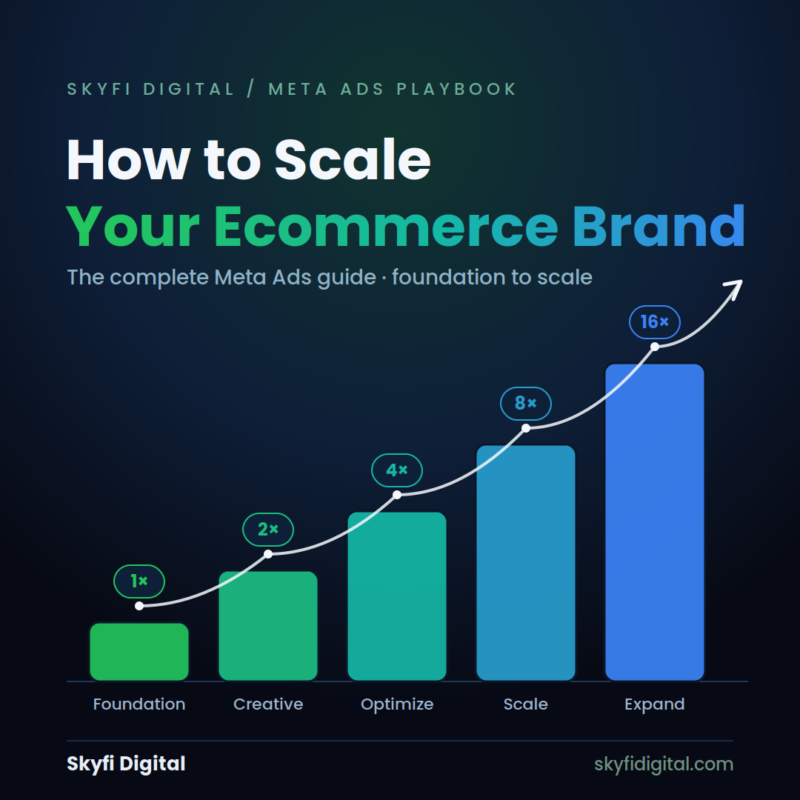
Scaling an ecommerce brand with Meta Ads comes down to four non-negotiable principles: a structured 3-pillar account that covers the full funnel, a disciplined creative testing system that generates winners consistently, audience logic built around your pixel data rather than guesswork, and scaling rules that protect ROAS instead of sabotaging it.
The framework above is what we run across every ecommerce client at Skyfi Digital. It’s behind our 4.6x average ROAS and the $20M in revenue generated from $5M in ad spend across Pakistan, the UK, and the US. There is no shortcut version — the results come from implementing the full system, not picking the parts that feel convenient.
If you want to know what ROAS we can realistically achieve for your store, book a free 30-minute strategy call — we’ll audit your current setup and give you a concrete growth plan, not a pitch deck.
Explore our performance marketing services to see what a full engagement looks like.
